The engineering and tech gender gap has barely budged in 50 years
Part of Teaching an AI Agent to Make Beautiful Charts
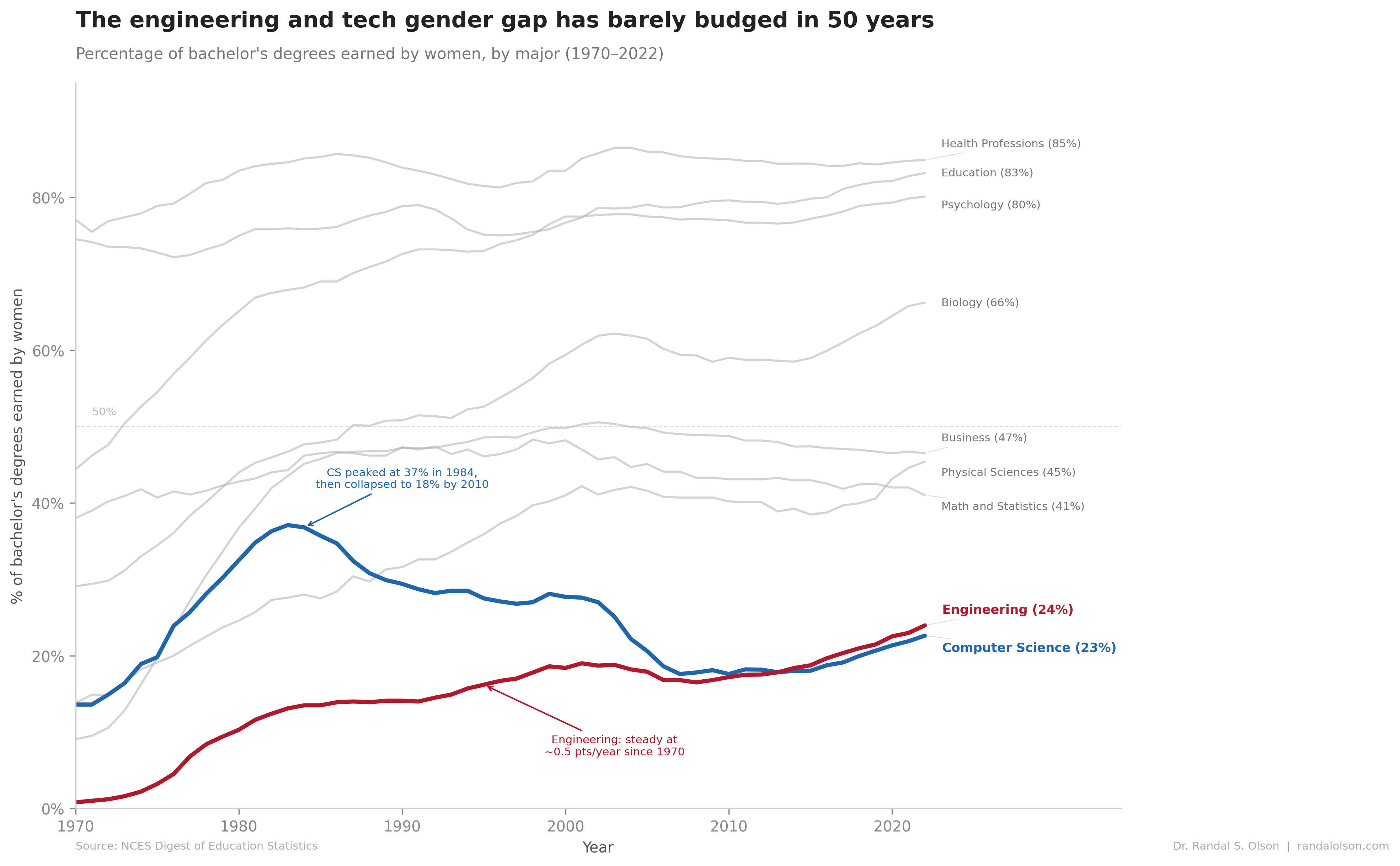
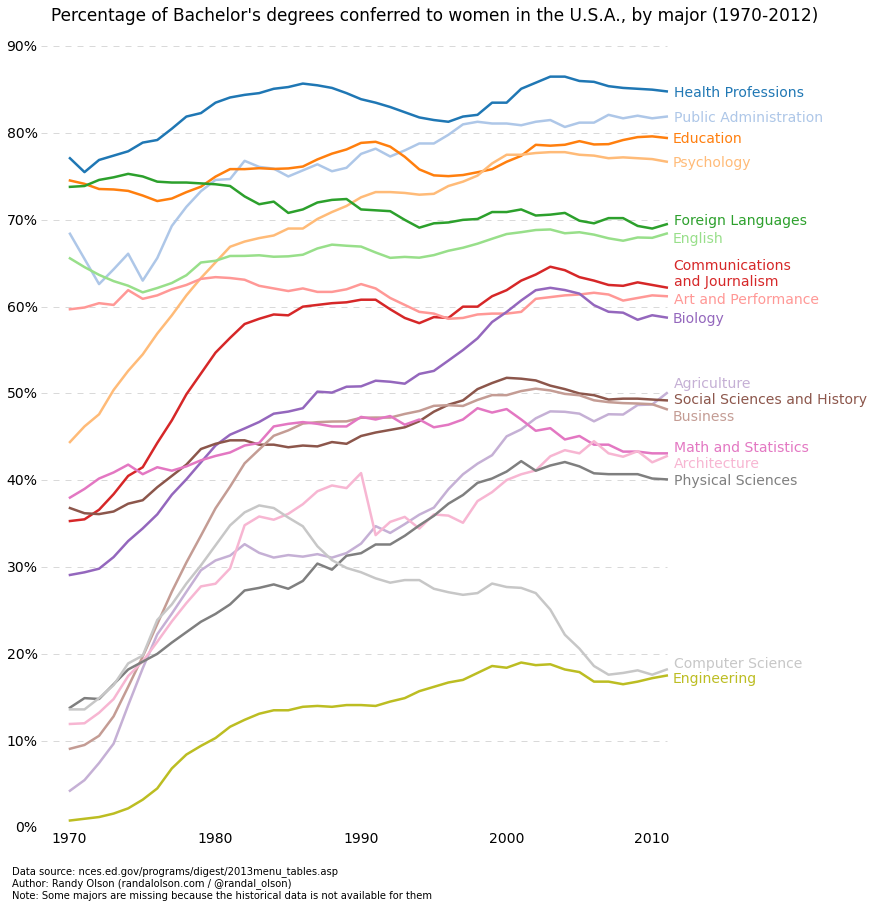
One of my most-shared charts from 2014 showed the percentage of bachelor's degrees earned by women across every major from 1970 to 2012. That post ended with Computer Science stuck at 18% women after a 30-year slide from its 1984 peak. A decade of new NCES data later, what changed?
Computer Science: lost decades, slow recovery
CS has an unusual trajectory. Women earned 37% of CS bachelor's degrees in 1984, then the number fell for nearly 30 straight years, bottoming out around 18% in 2010. NPR's Planet Money dug into this in 2014 and found that the decline started right when personal computers showed up in American homes, marketed almost entirely to boys.
Researcher Jane Margolis interviewed hundreds of CS students at Carnegie Mellon and found that families were far more likely to put the computer in a son's bedroom than a daughter's. By the time these students got to college, professors assumed everyone had been coding since middle school.
The good news: CS has been creeping back up, reaching 23% by 2022. That's the highest share since 1987, but still well below the 37% peak from four decades ago. At this pace of recovery, CS won't return to its 1984 level until the 2040s.
Individual schools have shown it's possible to move faster: Harvey Mudd went from 10% to over 50% women CS majors by redesigning its intro CS course and changing how it recruited. But scaling what one small college did to an entire national pipeline is a different problem.
Engineering: steady but glacial progress
Engineering went from 1% women in 1970 to 24% in 2022. That sounds like progress until you realize the growth has been roughly linear for 50 years. There was no sudden breakthrough, no inflection point where engineering suddenly became welcoming to women. Just a slow, grinding climb of about half a percentage point per year.
At 24%, engineering today sits where CS was in 1976. If the linear trend holds, engineering won't reach 37% (CS's 1984 peak) until the late 2040s.
The "ET gap" is real, the "STEM gap" is not
This was the main takeaway from the 2014 post, and the data only reinforces it. Biology hit 66% women by 2022. Physical Sciences climbed from 40% to 45% in the past decade. Math held steady around 41-43%. These fields are either at parity or within striking distance. The ones stuck far below are CS and Engineering.
The gender gap in STEM is really an Engineering and Technology gap. Title IX passed in 1972, two years into this dataset, and women surpassed men in overall bachelor's degrees by 1982. Most fields responded. CS and Engineering didn't.
Business quietly crossed 50%
Something often lost in the STEM conversation: Business crossed the 50% line around 2002 but has since slid back to 47% by 2022. It's the largest degree category by total enrollment, so even small percentage shifts represent tens of thousands of students. Business went from 9% women in 1970 to near-parity in one generation.
The fields at the top keep climbing
Health Professions (85%), Education (83%), and Psychology (80%) have been majority-female for the entire 52-year span of the data. Psychology stands out here: it crossed 50% around 1975 and has climbed steadily to 80%, one of the largest shifts in the entire dataset. All three center on direct human service work.
How this chart was made
An AI agent built this chart end-to-end as part of the Beautiful Charts with AI series. It compiled NCES data across multiple digest years, built the chart in Python, and iterated on the design until it passed the Tufte Test, a data visualization quality standard built by Goodeye Labs on Truesight.
Data source: NCES Digest of Education Statistics, table 318.30 (academic years 1970-71 through 2021-22). The 2021-22 academic year is the most recent available; NCES publishes with roughly a two-year lag. The compiled dataset is available here.
Tags
Related Posts

Dr. Randal S. Olson
AI Researcher & Builder · Co-Founder & CTO at Goodeye Labs
I turn ambitious AI ideas into business wins, bridging the gap between technical promise and real-world impact.