The rise and fall of nuclear weapons testing
Part of Teaching an AI Agent to Make Beautiful Charts
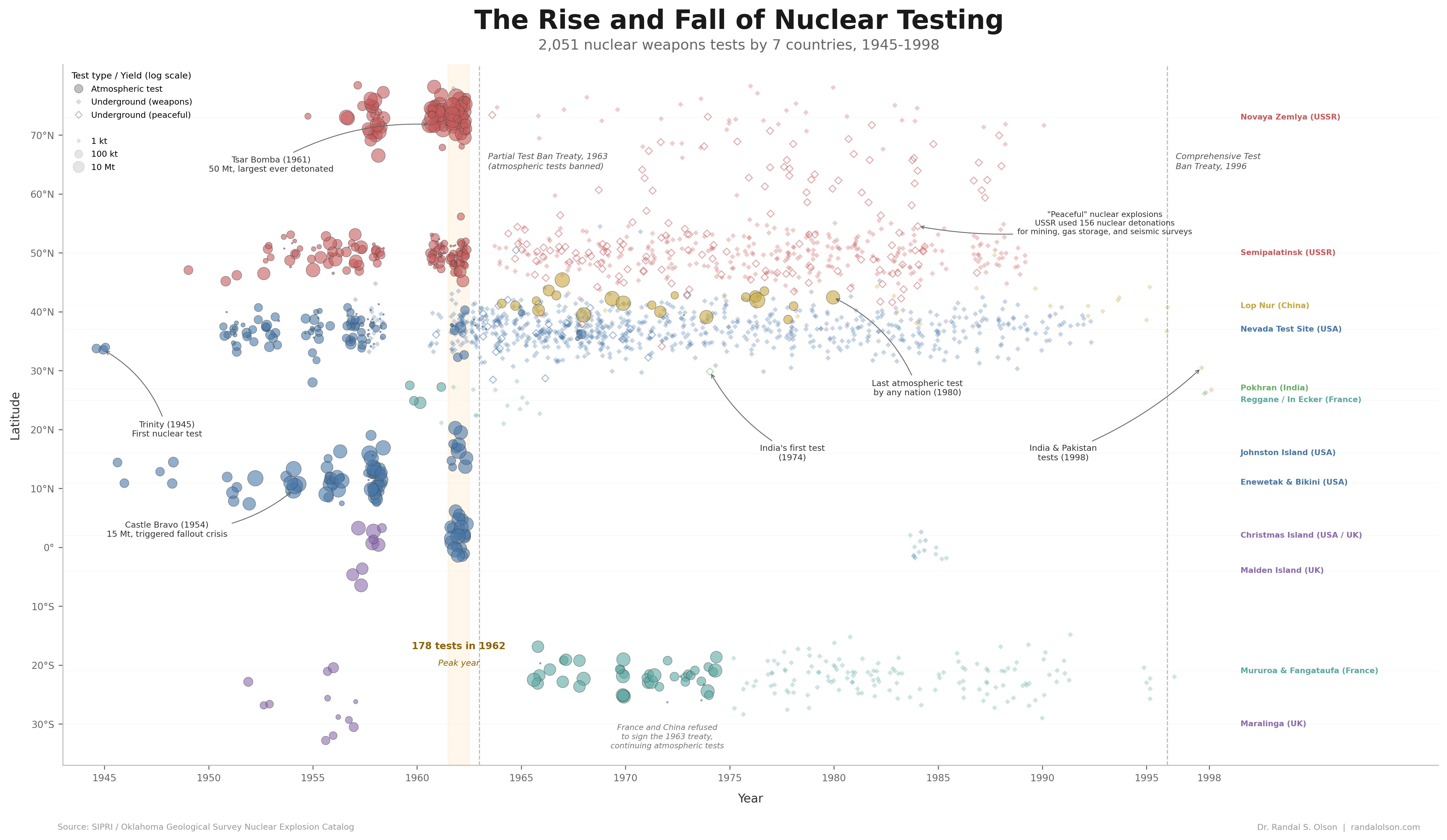
Between 1945 and 1998, seven countries detonated over 2,000 nuclear weapons. Not in wars, but in tests. The chart below plots every single one of them.
1962: the year the world detonated 178 nuclear weapons
The peak of nuclear testing came in 1962, with 178 detonations in a single year. To put that in perspective, that's one nuclear explosion every two days, sustained for an entire year. The U.S. conducted 96 tests and the Soviet Union conducted 78.
The surge started when the Soviet Union broke a three-year voluntary moratorium in September 1961 with a massive test series that included the Tsar Bomba, a 50-megaton hydrogen bomb and the largest nuclear weapon ever detonated. The U.S. responded with Operation Dominic, a rapid series of 31 atmospheric shots in the Pacific totaling 38 megatons. Both sides were racing to complete as many weapons design validations as possible before the anticipated test ban treaty took effect.
Four test sites bore the brunt
Over 2,000 nuclear weapons were tested at just a handful of sites. The Nevada Test Site alone hosted 928 tests, roughly 65 miles from downtown Las Vegas. In the 1950s, the mushroom clouds were visible from the Strip. The Las Vegas Chamber of Commerce published calendars listing scheduled detonation times and the best viewing spots. Casinos hosted "dawn bomb parties" for tourists.
The Soviet Union split its testing between Semipalatinsk in Kazakhstan (456 tests) and Novaya Zemlya in the Arctic (130 tests). Kazakhstan now recognizes more than one million citizens as victims of Soviet-era radiation exposure from Semipalatinsk. France conducted 193 tests at Mururoa and Fangataufa atolls in French Polynesia, the controversy over which led French intelligence to sink Greenpeace's Rainbow Warrior in Auckland harbor in 1985, killing photographer Fernando Pereira.
Strontium-90 in baby teeth ended the atmospheric era
The shift from atmospheric to underground testing is one of the clearest patterns in the chart: bold bubbles dominate the left side, then mostly vanish after 1963, replaced by small diamonds. The 1963 Partial Test Ban Treaty virtually eliminated above-ground nuclear detonations, and the reason was radioactive fallout showing up in children.
The turning point was the Baby Tooth Survey, a citizen science project launched in 1958 that collected over 320,000 baby teeth from children in St. Louis. Children born in 1963 had strontium-90 levels 50 times higher than children born in 1950. The isotope, a byproduct of atmospheric nuclear blasts, was entering the food chain through contaminated milk. These findings directly influenced President Kennedy's decision to sign the Partial Test Ban Treaty on August 5, 1963. Within five years, strontium-90 levels in the milk supply dropped by more than half.
156 nuclear explosions for "peace"
Not all underground tests were weapons. The hollow diamonds scattered across Russia at various latitudes are "peaceful" nuclear explosions. The Soviet Union detonated 156 nuclear devices for industrial purposes between 1965 and 1988: seismic sounding for oil and gas exploration, creating underground storage cavities, extinguishing runaway gas well fires, and even attempting to dig canals. The program was called "Nuclear Explosions for the National Economy," and you can see these tests scattered across dozens of sites far from Semipalatinsk.
India borrowed this playbook for its first nuclear test in 1974, codenamed "Smiling Buddha." By calling it a "peaceful nuclear explosion," India technically avoided violating the Non-Proliferation Treaty. Few countries bought the distinction.
From 178 tests a year to zero
After the 1962 peak, nuclear testing declined steadily for three decades. The Partial Test Ban Treaty pushed all testing underground, but it didn't reduce the total number of tests, and notably France and China refused to sign it. France continued atmospheric testing at Mururoa until 1974. China kept going until 1980, when it conducted the last atmospheric nuclear test by any nation.
What actually reduced testing was the end of the Cold War. The Soviet Union conducted its last test in October 1990, the UK followed in November 1991, and the U.S. ran its final test in September 1992. France and China held out until 1996, conducting their last tests just months before signing the Comprehensive Nuclear-Test-Ban Treaty.
The data ends at 1998, when India detonated five devices in May and Pakistan responded with six of its own just 15 days later. The only country to test since then is North Korea, which conducted six underground tests between 2006 and 2017.
How this chart was made
An AI agent built this chart end-to-end as part of the Beautiful Charts with AI series. Inspired by Minard's 1869 visualization of Napoleon's march, the chart uses a single coordinate space to encode six data dimensions simultaneously: year (x-axis), latitude (y-axis, which naturally groups test sites), explosive yield (bubble size), country (color), test type (atmospheric circles vs. underground diamonds), and purpose (filled diamonds for weapons tests vs. hollow diamonds for "peaceful" nuclear explosions). The AI agent iterated on the design until it passed the Tufte Test, a data visualization quality standard built by Goodeye Labs on Truesight.
Data source: SIPRI / Oklahoma Geological Survey Nuclear Explosion Catalog, compiled by data-is-plural. The full dataset is available here.
Beautiful Charts with AI
Want to test your own charts against the same quality bar?
Try the Tufte Test on your own chart, or get future updates on AI evaluation and chart quality from Goodeye Labs.

Dr. Randal S. Olson
AI Researcher & Builder · Co-Founder & CTO at Goodeye Labs
I turn ambitious AI ideas into business wins, bridging the gap between technical promise and real-world impact.