Every generation rediscovers art: 270 years of cultural interests in one chart
Part of Teaching an AI Agent to Make Beautiful Charts
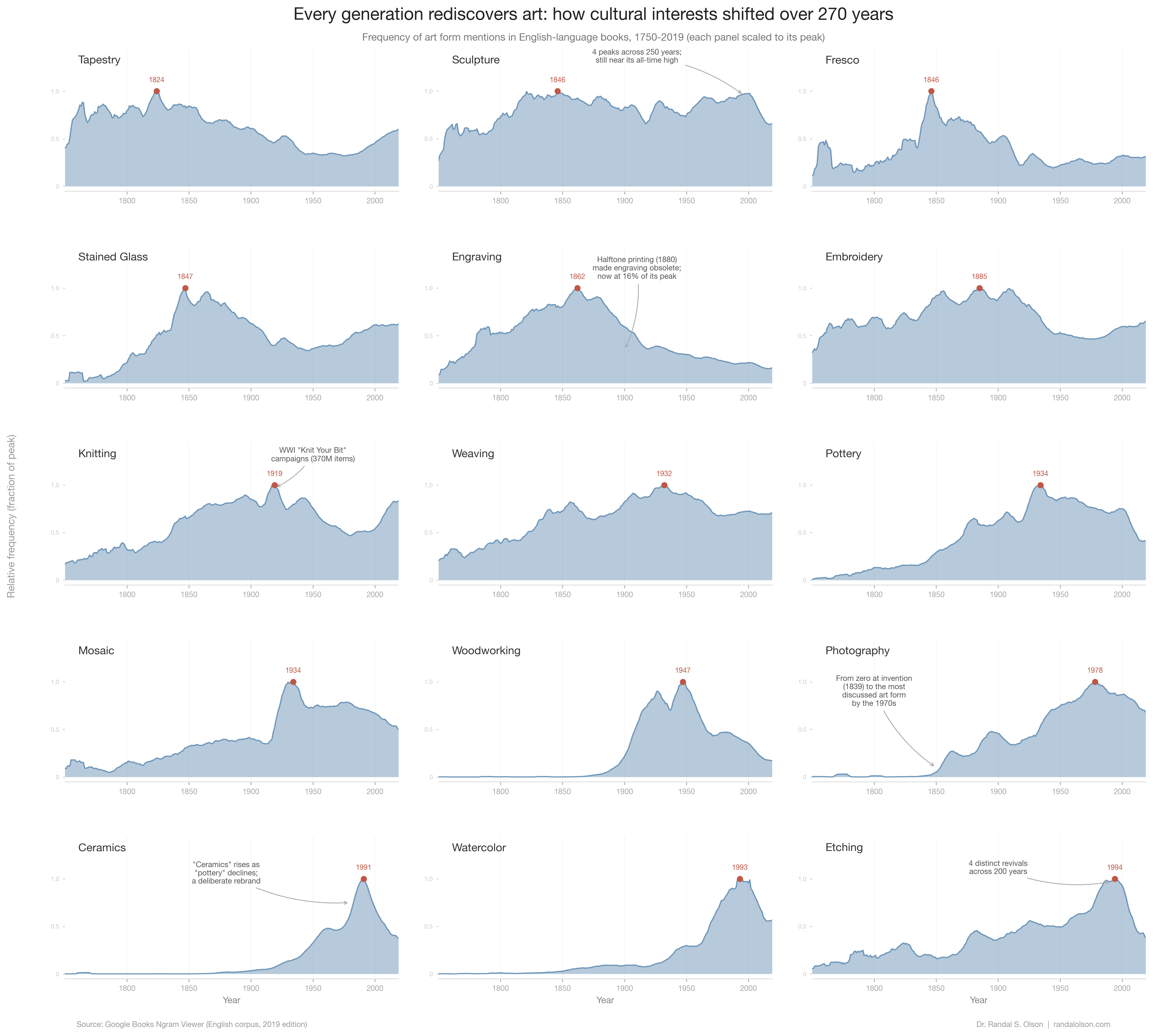
No art form stays on top forever. When a craft catches fire, people write about it: instruction manuals, exhibition catalogs, critical essays, histories. That published record makes the Google Books Ngram Viewer, which tracks word frequency across millions of English books, a surprisingly good thermometer for cultural interest in art forms over time. Plotting 15 of them across 270 years tells a clear story: each generation finds its own creative obsession, peaks, then fades as something new takes over.
Engraving ruled the 1800s, then photography killed it
Engraving was the dominant image reproduction method for over a century before photography made it obsolete in a single generation. Before cameras, every illustration in a book, newspaper, or magazine had to be carved by hand into a metal plate or woodblock. Engraving mentions peaked around 1862, the exact period when engravers were still essential but the writing was on the wall. Daguerre had announced his photographic process in 1839, and by 1861, books were already using photography-aided wood engraving.
The real death blow came on March 4, 1880, when the New York Daily Graphic published the first halftone photograph in a newspaper. Within 15 years, halftone screens had replaced engraving in most publications. The craft retreated from commercial work into fine-art printmaking, where it remains today as a niche pursuit.
The Arts and Crafts Movement tried to turn back the clock
Embroidery's peak around 1885 maps almost exactly onto the height of the Arts and Crafts Movement. William Morris founded Morris & Co. in 1861 to produce hand-crafted decorative arts as a deliberate counter to industrial mass production. He considered Victorian machine-made needlework a degradation of the craft, and his firm's embroidery, tapestry, and textile work revived techniques that had been abandoned for decades.
The movement had institutional backing, too. The Royal School of Needlework was founded in 1872 specifically to restore "ornamental needlework to the high place it once held amongst decorative arts." Morris's daughter May Morris became the leading practitioner of art embroidery within the movement. But the revival was swimming against the industrial tide, and by the early 1900s, mentions of embroidery had begun their long decline.
Two world wars turned knitting into a patriotic duty
Knitting spiked around 1919 because governments turned it into a war effort. When the U.S. entered World War I, the American Red Cross set an immediate target: 1.5 million each of knitted wristlets, mufflers, sweaters, and socks. The campaign slogan was "Knit Your Bit." Local chapters distributed standardized patterns and yarn in Army khaki and Navy blue.
The scale was hard to believe. Red Cross volunteers produced an estimated 370 million knitted items using 45 million pounds of wool during the 18 months the U.S. was at war. Red Cross membership exploded from 17,000 to over 20 million. The 1919 Ngram peak reflects a publishing lag: the actual knitting frenzy peaked in 1917-18, and books about the campaigns followed a year or two later.
Pottery became ceramics, and it wasn't just a name change
The data shows two distinct peaks for clay-based art: "pottery" around 1934 and "ceramics" around 1991, and the two peaks tell different stories. The pottery peak coincides with the studio pottery movement launched by Bernard Leach, who co-founded his St Ives pottery with Shoji Hamada in 1920 and published A Potter's Book in 1940, often called "the potter's bible."
By the 1970s and 1980s, a new generation of clay artists pushed back against the Leach school's emphasis on functional vessels and Japanese aesthetics. Artists working in sculptural and conceptual modes deliberately adopted "ceramic artist" and "ceramics" over "potter" and "pottery" to claim fine-art status. The Ngram data captured what actually happened in studios and galleries: a generational break with the past.
Photography: from zero to cultural dominance in 140 years
Photography went from zero mentions before 1839 to the most-discussed art form by the late 1900s. The Kodak Brownie, launched in 1900 at $1, sold 10 million units in five years and put cameras in the hands of people who had never made a picture before. That was when photography stopped being a specialist technology and became a universal cultural practice.
Artistic legitimacy came slower. Alfred Stieglitz's 291 gallery in New York (1905-1917) was the first sustained effort to exhibit photographs as fine art alongside paintings. MoMA established its Department of Photography in 1940, the first major art museum to formally recognize the medium. But broad institutional acceptance didn't arrive until the late 1970s, which aligns almost exactly with the Ngram peak around 1978.
How this chart was made
An AI agent built this chart end-to-end as part of the Beautiful Charts with AI series. The small multiples format was chosen to show all 15 art forms with individual year axes, so each trajectory is readable without scrolling. Each panel is normalized to its own peak so that smaller art forms (like watercolor) are as visually clear as dominant ones (like photography). The chronological sorting by peak year flows left-to-right, top-to-bottom, revealing the generational wave. The chart was evaluated against the Tufte Test, a data visualization quality standard built by Goodeye Labs on Truesight.
Data comes from the Google Books Ngram Viewer (English corpus, 2019 edition), which tracks word frequency across millions of published books from 1500 to 2019. The raw data is available as a CSV download.
Beautiful Charts with AI
Want to test your own charts against the same quality bar?
Try the Tufte Test on your own chart, or get future updates on AI evaluation and chart quality from Goodeye Labs.

Dr. Randal S. Olson
AI Researcher & Builder · Co-Founder & CTO at Goodeye Labs
I turn ambitious AI ideas into business wins, bridging the gap between technical promise and real-world impact.