130 years of Boston Marathon winning times
Part of Teaching an AI Agent to Make Beautiful Charts
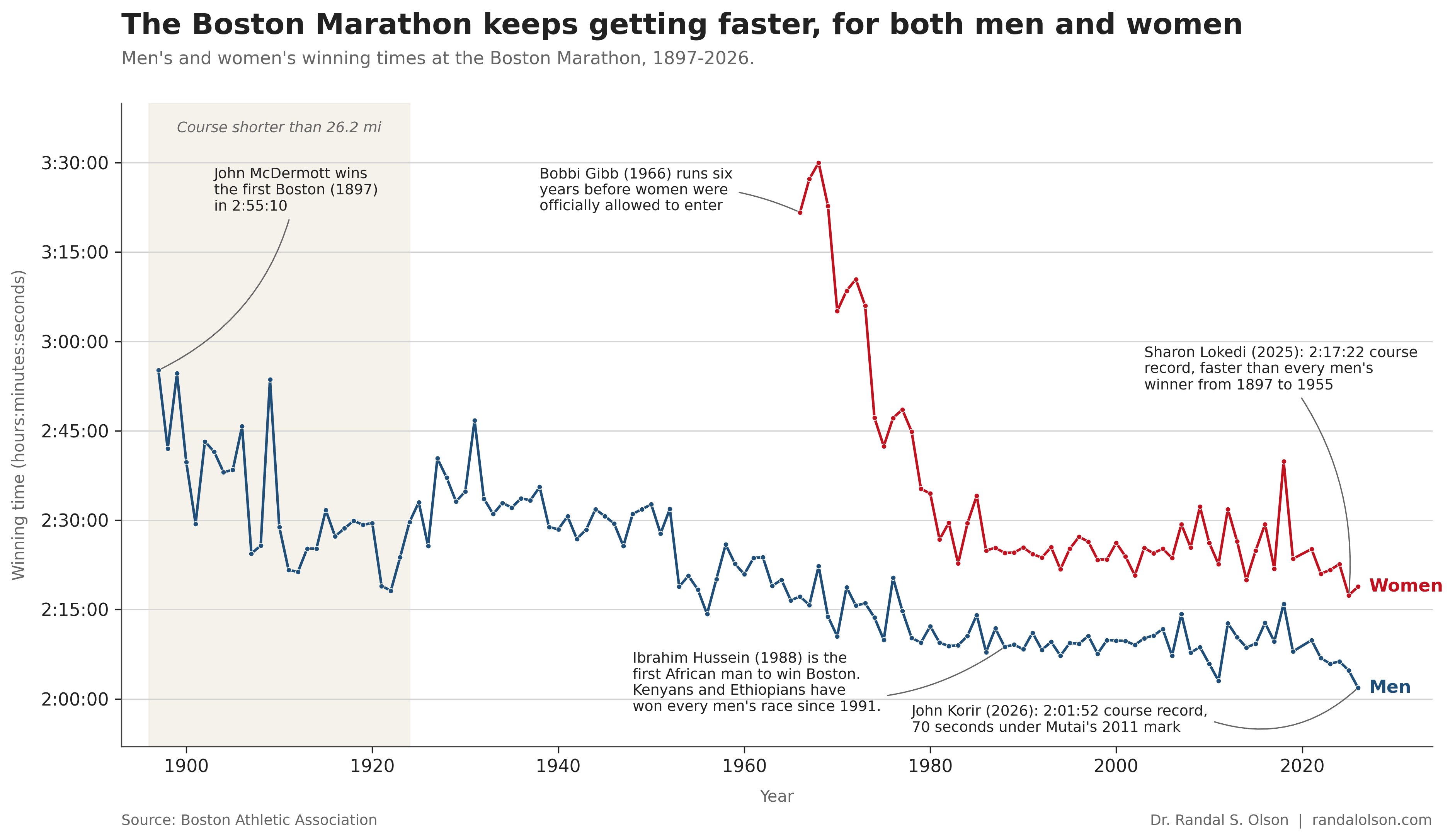
On Monday, Kenya's John Korir ran 2:01:52 at the Boston Marathon and broke a course record that had stood for 15 years. The previous mark, Geoffrey Mutai's 2:03:02 in 2011, lasted longer than any other in the modern era. Korir beat it by 70 seconds, and two other runners also finished under the old record. The chart below puts that performance in the context of every winning time since 1897.
The first race was 24.5 miles and had 15 runners
John McDermott of New York won the first B.A.A. Marathon on April 19, 1897 in 2:55:10. He beat a starting field of 15 runners, of whom only 10 finished. The course ran 24.5 miles from Ashland to the Irvington Oval near Copley Square, shorter than the 26.2 miles that became the marathon standard after the 1908 London Olympics. The race itself was a direct import from the 1896 Athens Olympics. B.A.A. track coach John Graham had just managed the U.S. team in Athens, came home inspired, and organized a Boston version on Patriots' Day. It is now the oldest annual marathon in the world.
Women were not allowed to enter until 1972
In 1966, Bobbi Gibb hid in the forsythia bushes near the Hopkinton start, jumped into the pack after the gun, and ran the entire course in 3:21:40. She had written to the B.A.A. for an entry form two months earlier, and race director Will Cloney had rejected her with the claim that women were not physiologically capable of the distance. Gibb beat two-thirds of the men's field that day.
Women's entries were not officially sanctioned at Boston until 1972, when Nina Kuscsik won the first official women's race. Once the door opened, the progression was extraordinary. The women's winning time dropped by nearly an hour over the next two decades, from Gibb's 3:21:40 in 1966 to Rosa Mota's 2:24:30 in 1988. The line falls steeper on the chart than the men's line ever has.
East Africans transformed the men's race after 1988
Ibrahim Hussein won Boston in 1988 in 2:08:43, edging Tanzania's Juma Ikangaa by one second. He became the first African man to win the race. Since 1991, a Kenyan or Ethiopian has won the men's Boston Marathon every year except three: Lee Bong-ju of South Korea in 2001, Meb Keflezighi of the U.S. in 2014, and Yuki Kawauchi of Japan in 2018.
The pattern is not an accident of any single marathon. Peer-reviewed research attributes East African distance-running dominance to a combination of chronic high-altitude training in Kenya's Rift Valley (Iten sits near 8,000 feet), biomechanical efficiency, a training culture built around large groups of world-class athletes, and powerful economic motivation. Boston's prize money alone runs to $150,000 for the winner, plus a $50,000 course-record bonus. Korir walked away with $200,000.
The women's course record is faster than most men's winners in history
Sharon Lokedi of Kenya won Boston in 2025 in 2:17:22, cutting 2 minutes 37 seconds off the 11-year-old women's course record. She repeated in 2026 with a 2:18:51. Her 2025 record is faster than every men's winning time at Boston from 1897 through 1955. It would still have won the men's race in 70 different years of the race's history, including every year of the first 59 races.
The 2026 time is even sharper. 2:18:51 is the exact time Keizo Yamada ran to win the men's race in 1953. The women's line has caught up to where the men's line was in the mid-1950s. Women were still 19 years away from being officially allowed to enter the race at that point.
Korir's record and the super shoe era
Korir's 2:01:52 is the fifth-fastest marathon ever run. It came 15 years after Mutai's 2:03:02, which itself was run with a strong tailwind and stood as the unofficial world best until regulators changed the rules. The gap between them is almost entirely a super shoe story. Nike introduced the Vaporfly 4% in 2017, and peer-reviewed studies of elite race data have since estimated the shoes are worth between one and three percent. Every major shoe brand now builds its own carbon-plated, foam-stacked race shoe.
The top of the field at Boston this year ran in some variant of this technology. Three men broke Mutai's old course record in a single race. Alphonce Simbu of Tanzania finished second in 2:02:47, and Benson Kipruto of Kenya finished third in 2:02:50. Korir's older brother Wesley won Boston in 2012, making them the first pair of brothers to win the race.
How this chart was made
An AI agent built this chart end-to-end as part of the Beautiful Charts with AI series. It researched the data, built the chart in Python, and iterated on the design until it passed the Tufte Test, a data visualization quality standard built by Goodeye Labs on Truesight.
Data source: Boston Athletic Association race champions, with cross-verification from the Wikipedia list of winners. The full dataset is available here.
Beautiful Charts with AI
Want to test your own charts against the same quality bar?
Try the Tufte Test on your own chart, or get future updates on AI evaluation and chart quality from Goodeye Labs.

Dr. Randal S. Olson
AI Researcher & Builder · Co-Founder & CTO at Goodeye Labs
I turn ambitious AI ideas into business wins, bridging the gap between technical promise and real-world impact.