Artemis II ended humanity's 54-year confinement to low Earth orbit
Part of Teaching an AI Agent to Make Beautiful Charts
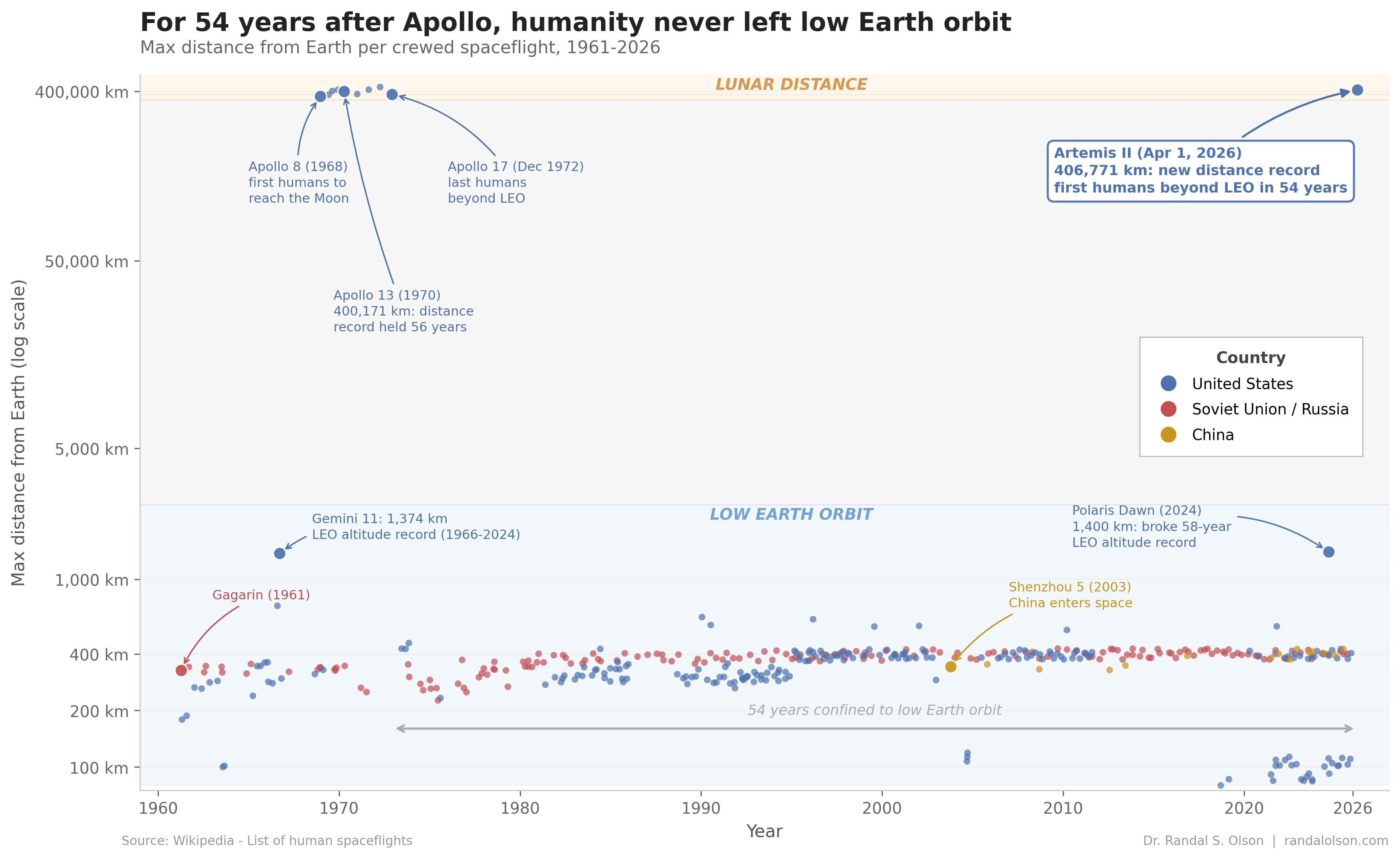
On April 10, 2026, 4 astronauts splashed down in the Pacific after flying farther from Earth than any humans on record. The Artemis II crew reached 406,771 km on a free-return loop around the Moon, eclipsing Apollo 13's 400,171 km from April 1970. The chart below places every crewed spaceflight since Yuri Gagarin in context: year on the horizontal axis, maximum distance from Earth on the vertical axis (log scale).
The Apollo window: 9 missions in 5 years
Between December 1968 and December 1972, 9 crewed missions reached lunar distances. 8 orbited the Moon, and Apollo 13 looped around after an oxygen tank explosion forced the crew to abort the landing. On the chart, the Apollo missions form a tight cluster near 400,000 km, about 1,000 times higher than the ISS orbits today.
Apollo ended because the goal was met and the money ran out. Once Neil Armstrong and Buzz Aldrin walked on the Moon in July 1969, the political rationale for racing there dissolved. NASA's budget had been falling since 1966, and the Nixon administration redirected funds toward Skylab and the Space Shuttle. Apollos 18, 19, and 20 were canceled. Apollo 17 launched in December 1972, and no human left Earth orbit again until April 2026.
Which Apollo mission holds the distance record?
The official answer is Apollo 13. NASA's April 2026 press release credited Apollo 13's 400,171 km as the mark Artemis II broke, and Guinness World Records lists the same mission. Artemis II exceeded that distance at 12:56 p.m. CDT on April 6, 2026, Flight Day 6.
The measurement geometry makes this question harder than it looks. The Earth-Moon distance varies by roughly 43,000 km over the course of a year, and which point on Earth you measure from shifts the result by another 12,000 km. The AIAA Houston paper on this question walks through the calculation in detail. Either way, Artemis II flew past all of them.
54 years at the wall
After Apollo 17, every crewed spaceflight for 54 years stayed inside low Earth orbit. The ISS orbits at about 400 km. The Space Shuttle's highest flights were the Hubble deployment and servicing missions, which reached around 600 km. The dense stripe of dots between 300 and 600 km represents the bulk of those 403 post-Apollo missions, from Salyut to Mir to decades of ISS rotations, all confined to the same narrow band. Polaris Dawn pushed the LEO ceiling to 1,400 km in 2024 (more on that below), but no crew left orbital space entirely until Artemis II.
The dark middle band on the chart, from 2,500 km to 360,000 km, has 0 dots. That gap is not a data error. No crewed mission has achieved orbit in that range. For 54 years, human spaceflight had a hard ceiling at a few hundred kilometers, and the chart makes that compression visible in a way that a timeline alone cannot.
2 altitude records, 58 years apart
2 missions sit visually apart from the LEO cluster without reaching the Moon: Gemini 11 in 1966 and Polaris Dawn in 2024, both visible as isolated dots above 1,000 km in the blue LEO zone.
In September 1966, Pete Conrad and Dick Gordon used the Agena Target Vehicle's engine to boost Gemini 11 to 1,374 km, the highest Earth orbit ever flown. The Shuttle had no reason to go that high, the ISS sits at 400 km, and the record simply persisted for 58 years. In September 2024, SpaceX's Polaris Dawn crew flew to 1,400.7 km to study Van Allen radiation effects on the human body, finally breaking the mark. Both missions appear in the chart as isolated dots at nearly the same height, separated by 58 years on the x-axis.
How this chart was made
An AI agent built this chart end-to-end as part of the Beautiful Charts with AI series. It researched the data, built the chart in Python, and iterated on the design until it passed the Tufte Test, a data visualization quality standard built by Goodeye Labs on Truesight.
Data source: List of human spaceflights on Wikipedia (412 missions through Artemis II, April 2026). Apollo lunar distances from NASA mission records; Artemis II distance from the NASA press release, April 6, 2026.
Beautiful Charts with AI
Want to test your own charts against the same quality bar?
Try the Tufte Test on your own chart, or get future updates on AI evaluation and chart quality from Goodeye Labs.

Dr. Randal S. Olson
AI Researcher & Builder · Co-Founder & CTO at Goodeye Labs
I turn ambitious AI ideas into business wins, bridging the gap between technical promise and real-world impact.